Showing posts with label tool and die shop. Show all posts

Monday, May 6, 2019

Interesting Die and Tooling Stuff

Interesting Tool and Die Stuff, May 6th Dump

This is no canyon, this is a crack in a steel bar from an electron microscope. I would still visit their though, if I could get myself small enough.


Here's our floor managers new tool. The cat o' nine tails, this keeps the shop floor running!

Thanks from the massive team of writers, editors and artists here at the Carbide Dies Blog!

Tuesday, September 23, 2014

How to become a Die Maker


When it comes to metalworking trades tool and die makers are at the top. They are extremely versatile with their hands for creating parts, as well as with machines to produce high precision parts. Their abilities go beyond that of the average machinist. They are capable of designing and fabricating tools with no supervision. With these skills available, tool and die makers are a tremendous asset in any manufacturing facility.

Steps to become a Die Maker Step 1
1. Master basic math. Understand addition, subtraction, and division. Knowing some shop trigonometry is good for calculating bolt circles and finding the length of triangles. Basic algebra can also be handy for applying handbook formulas

Become a Die Maker Step 2
2. Learn computer drafting. Vocational and technical schools' machining programs are a good place to learn these types of skills. Learn to create and interpret mechanical drawings.

Become a Die Maker Step 3
3. Enter an apprenticeship program at a tool and die shop while in high school, if possible. Apprentices do simple tasks such as drilling, de-burring, and sweeping in the beginning. Tasks will become more challenging as time goes on. Apprentices learn the lathe, mill and surface grinder. Apprenticeships typically last 2 to 4 years.

Become a Tool and Die Maker Step 4
4. Study machine tool technology at a good vocational trade school. Programs vary from school to school so make sure you are studying at one that has various machines to learn from, such as a wire EDM (electrostatic discharge machining) tool. Also, make sure they have good CNC (computer numerically controlled) programming courses, as this will make things easier later in your career. Try to get hands-on experience in a shop as well, rather than studying strictly in a classroom. The heart of your education will be in the types of projects you will be making in the course. A typical machine tool technology program will last two years.

Become a Die Maker Step 5
5. Get a copy of the Machinery Handbook and refer to it often. This is an excellent reference for answering any machining problem.

Become a Tool and Die Maker Step 6
6. Buy a set of good high quality precision tools like 1-2-3 inch micrometers, and a square set, along with a 7- or 11-drawer machinists toolbox. An electronic caliper is a plus also. Try to stay away from generic tools because these seem to be less durable. Instead, invest in high quality tools like Starrett and Mitutoyo, top names in the trade. If money is tight, obtain tools gradually, as you need them, over time, until you have your own set. Get the ones you need most first.

Become a Die Maker Step 7
7. Once you land a job, focus on gaining experience. Learn from veteran tool and die makers. They can and often will share many tips they have learned over the years.

Become a Die Maker Step 8
8. Talk with other tool and die makers on the Internet in various discussion forums especially concerning CNC programming. Learning from those who have done it for years is the best way to help your career.

Become a Die Maker Step 9
9. Read metalworking trade publications in your spare time. Leave trade magazines in your bathroom.

Become a Die Maker Step 10
10. If you want to further your career in the tool and die trade, you may want to move into supervision or teaching. A Bachelor's degree in almost any field along with tool and die experience can be very beneficial in obtaining a supervisor's job in manufacturing and/or teaching.

Monday, July 7, 2014

Where are Carbide Die Companies Located?

Tool and die is the heart of manufacturing, specialized workers make the parts that make the parts. These dies need to be made special, one at a time by skilled die makers. Unfortunately, the number of companies that do this has been contracting since the late 90's. However, current trends show that this may be reversing. Particularly among highly specialized die makers, such as carbide die companies. So where are these companies located?

According to the US bureau of Labor Statistics (2001 to 2010)
Top States in Tool, Die, and Mold Employment  States ranked by 2010 employment.

State                  2001              2010              Percent Change 
Michigan          30,208           18,871                     -27%
Ohio                17,056           11,075                     -28
Illinois              12,822             6,815                     -31
Pennsylvania    11,811             6,476                     -30
Wisconsin          7,309             5,359                     -13
Indiana               8,571            5,228                     -31
California           7,253             4,885                     -23
Missouri             4,371            3,133                     -11
New York          5,171            2,783                    -30
Minnesota           3,933            2,749                    -13

Clearly, tool and die companies are mostly located in the Midwest of the United States. American tool and die companies face there toughest competition from Japan, although the Japanese manufacturers face longer lead times. This extended lead time causes problems due to lean manufacturing principles. Currently the Chinese tool and die industry seems to only be producing lower quality tooling. This is particularly true in the carbide die industry, where the Chinese dies tend to fall apart under the rigors of mass production. This causes damage to other tooling and I have heard more than one person comment that they are "garbage".

Tool and die is a vital resource for any manufacturing economy, and one that America would do well to maintain.

Wednesday, June 18, 2014

Tool & Die Life

As we all know, tool and die can be frustrating at times. Late parts, people freaking out about machines being down. These are called Yelling Plants. People spend there time screaming about how tens of thousands of dollars are being lost because a certain die isn't here. So relax for a second and enjoy...

 "Tis not our job to ask why, tis our job to tool and die"

Also, check out the tool and die quotes


Thursday, June 6, 2013

Tool and Die Quotes and Sayings

Machinists are famous for making everything we use or the parts that make the things we use... but only slightly less know for their quotes and colorful phrases.  Terms like screw, tailstock, ball, butt and nuts are common. So here are some of the quotes that have come out of the tool and die trade, enjoy!

A machinist is a man that washes his hands before and after he pees.

Last week I couldn't spell Machinist now I are one!

"Machinist's do it accurately"

Machinists do it "round and round" and "up and down.

"Happiness is a good tight screw".

Your car cost $40,000, So What, My machine cost $150,000 and it will make car parts.

If you Break it We can Make.

I worked my whole life as a Machinist, and all I got was Dead Nuts!

May the laws of physics be with you

You can always tell a good Master machinist, They still have all of there fingers!

It can be done three ways:
           GOOD
           FAST
           CHEAP
You only get to pick two of the three
If it is done GOOD and FAST it can't be CHEAP.
If it is done GOOD and CHEAP it can't be FAST.
IF it is done FAST and CHEAP it can't be GOOD.

"He who does not specify what he wants, deserves what he gets."

MINE IS NOT TO ASK WHY
MINE IS JUST TO TOOL AND DIE !

I am a Machinist. My ability to create is limited only by you inability to envision.

GOD must've been a Machinist with a killer piece of stock.

I am a Machinist. I didn't envision, plan, or design this part. But if you leave me alone long enough, I'll make it work.

The Hindenburg and the Titanic. Don't blame the Machinists. We just make whatever the Enigneers design.

Tuesday, October 4, 2011

Historic Machine Shop

If anyone who is interested in machining gets a chance they should visit Greenfield Village in Dearborn, Michigan. There is a historic machine shop located here, it is called the Armington & Sims Machine Shop & Foundry. You can see how it was done in the old days! Powered by a steam engine (I'm not sure if they still use steam power for the engine) poles run along the top of the machine shop. Belts drop down from these poles to power all the wonderful old machines. You can see some of the same names we use today on these machines, I particularly enjoyed watching an old 1908 Brown & Sharpe No. 2 make a candle stick.
Another neat thing about the shop, particularly in the fall, is the layout. The machine shop is laid out like a cathedral to industry. Large windows flank a long building layout, although they aren't stained glass! During the cool fall day I visited a nice breeze blew threw and it was very comfortable and well lit, both very important for machine shops.

So if your in the Detroit area and interested in tool and die or machining then stop by Greenfield Village and see for yourself. Admission is about $35 dollars though, so you better like the other things they have there, and there's plenty to choose from!

Monday, June 6, 2011

Carbide Tooling


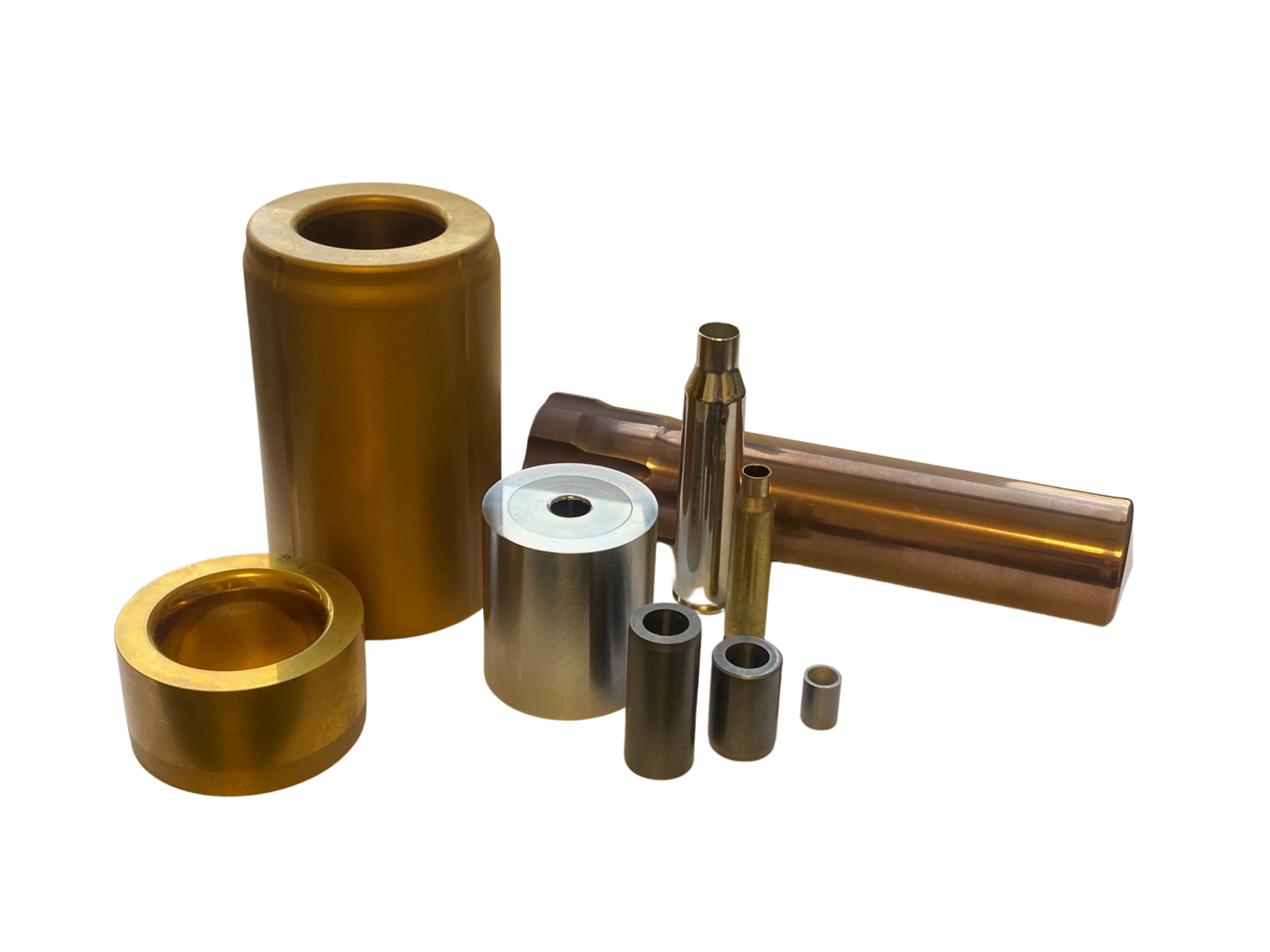
Carbide tooling is necessary for any cold forming, cold heading or extrusion process. Basically carbide tooling consists of anything that assists in the forming process besides the carbide dies. They are used to pound slugs into dies, cut off wires at set lengths and anything else that requires a durable part that can stand up to the punishing action of cold forming and heading. Tungsten carbide is used for this kind of tooling due to its extreme hardness and durability. In fact carbide tooling last four times longer than comparable steel tooling and this means less down time for machines and changing tooling out less frequently. In the long (or short) run, this means greater efficiency and profit.


A commonly used example of carbide tooling is a punch. Carbide punches have the punishing task of being slammed into metal slugs with enough force to cause them to form to the shape of a carbide die. Obviously this is one area where you don’t want to employ a weaker part! Think of carbide punches like the head of a hammer.


Another place where you will find carbide tooling used in the cold forming process is at the other end of carbide dies. Wire is created by forcing material through a drawing die, once through the draw die a piece of carbide tooling called a cut-off knife is used to cut the wire to length. Carbide cut-off knives can be employed anywhere where tough cuts are needed, and cutting wire will dull any edge quickly so once again carbide is used do to its hardness.


Carbide tooling obviously wears down during usage and eventually has to be replaced. How long it lasts depends on how much pressure the tools are under and the material they are being used to form. Cold forming steal will wear out tooling at a much faster rate than cold forming copper for example. Companies can often save money by sending their tooling to carbide die companies to be reworked. This will extend the life of the carbide tooling and it’s a lot cheaper then replacing tools every time they wear out.


Here’s a list of examples of carbide tooling.


• Nibs• Cut-Off Knives• Mandrels• Punches• Quills• Inserts• Annular Rings• Bushings
• Bearings• Shafts

How Precision Carbide Dies Deliver Measurable Manufacturing Gains

Tooling should support your production goals — not hold them back. In industries like wire drawing, fastener production, extrusion, and tube...