
Showing posts with label dies. Show all posts

Thursday, October 13, 2022

The History of Tungsten Carbide

Henri Moissan first synthesized tungsten carbide in the 1800's creating perhaps the most useful

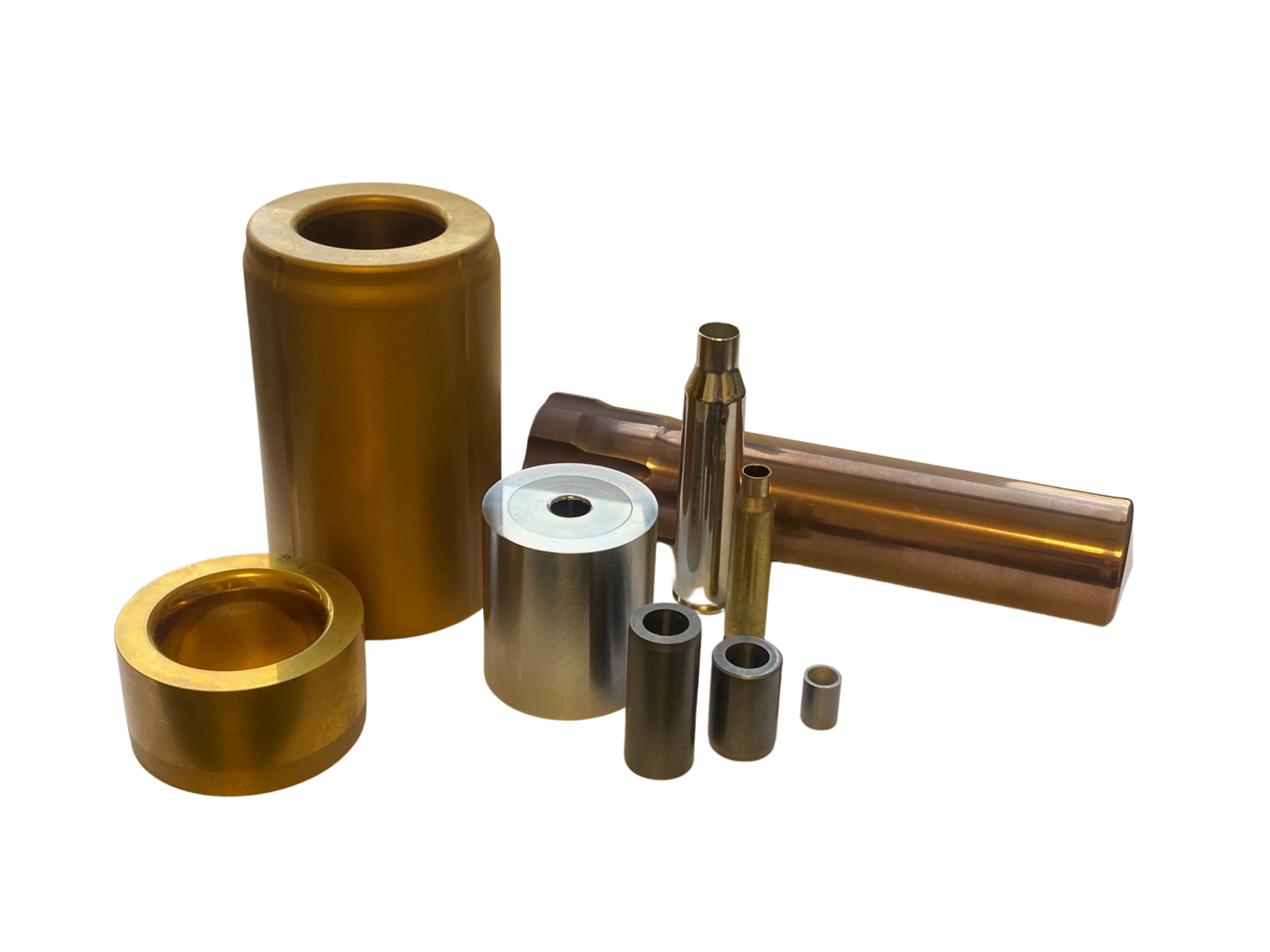
Tungsten Carbide Bushings


substances for metal forming known to man. Tungsten carbide is almost as hard as diamond and can be produced at a fraction of the cost. Tungsten carbide is now used in a wide variety of metal forming applications, from carbide dies to long lasting cutting tools. Here's a quick look at its fascinating history!

After Henri Moissan discovered tungsten carbide it took two other men to make it useful in the field of metal forming. The Osram Lamp Works in Germany needed a cheaper alternative to diamond dies for drawing the wires to be used in their lamps. Karl Schroeter and Heinrich Baumhauer experimented with bonding carbide with other metals  as cobalt, and the tungsten carbide industry was born sine it provided the necessary toughness to be used in their metal drawing process.

After that the notorious industrialist and arms manufacturer Friedrich Krupp and his company purchased the patent and further developed the sintering process. In the US the General Electric Corporation formed licenced use of the patent from Krupp and formed the Carboloy Company in order to produce tungsten carbide in the United States. The Carboloy company branded their tungsten carbide as "Carboloy." Carboloy tools were tested in General Electric plants and came to public attention and offered to the publiaround 1928.

Soon other patents and advancements were put forth, for example Dr. Balke invented a tantalum carbide that was sintered with nickel, creating a superior steel cutting alloy. Dr. Balke's material, called Ramet, was resistant to the pitting while cutting steel that typical resulted in premature wearing of carboloy.

Other advancements were made throughout the 1930's in the USA as the metallurgist Philip McKenna of the Vanadium Alloy Steel Company improved upon the pitting issue and created a titanium carbide alloy. 

As development of tungsten carbide continued its price dropped considerably, going from extremely expensive (but nowhere near the cost of the diamonds it replaced!) to a standard in manufacturing across a wide varieties of industries. Originally carbide was used very sparingly due to its high cost of manufacturing, to save on tungsten carbide it would only be used on the tips of cutting tools for example through the use of brazing techniques. However, as the 19th century progressed and its cost decreased large carbide dies and tools have become common. 

Today carbide dies are used in the cold forming industry to make all sorts of nuts, bolts and millions of other forms. The mining industry makes frequent use of tungsten carbide in their drills, ammunitions manufacturers use them to form shell casings and even some ballistics. Honestly, this section of the article describing it's multiple uses across a wide variety of industries could balloon into a book. Tungsten Carbide in all its varieties will be a major part of production long into the future!


Monday, September 11, 2017

Machining Small Carbide Dies

So we get quote requests at my work for some really small medical stuff made out of carbide and I always wanted to know how you could grind something that small. Wouldn't it be cool to have a machine shop that can fit on a 5' x 3' desk? Let's see if I can get a plan together that will allow me to make small tooling in a small space. So here's some photos of little machines that you could put some little diamond wheels on and grind some tungsten tungsten carbide dies (or any other tooling your little heart desires). It gives me pleasure to imagine a flee circus sized machine shop, maybe this is how elves do their machining?

So here's a little surface grinder, but it still might be a little big...

OK, this one will fit on my desk. Now I'm going to need a lathe...

Here's one from Harbor Freight for $139. OK, now for a drill press...

Your desk top machine shop can have the "big" one pictured for $109. But to make carbide dies we are going to need some ID/OD grinders. Let me see what little grinders I can find to fit on my desk.


Well, back to the drawing board. The only small grinder I could find was for coffee (maybe it can be modified with diamond wheels :)  -  I'm not going to be able to make carbide dies and tooling with my desktop machine shop. However, someone could definitely have some fun as a hobby machinist with this stuff!

Tuesday, September 23, 2014

How to become a Die Maker


When it comes to metalworking trades tool and die makers are at the top. They are extremely versatile with their hands for creating parts, as well as with machines to produce high precision parts. Their abilities go beyond that of the average machinist. They are capable of designing and fabricating tools with no supervision. With these skills available, tool and die makers are a tremendous asset in any manufacturing facility.

Steps to become a Die Maker Step 1
1. Master basic math. Understand addition, subtraction, and division. Knowing some shop trigonometry is good for calculating bolt circles and finding the length of triangles. Basic algebra can also be handy for applying handbook formulas

Become a Die Maker Step 2
2. Learn computer drafting. Vocational and technical schools' machining programs are a good place to learn these types of skills. Learn to create and interpret mechanical drawings.

Become a Die Maker Step 3
3. Enter an apprenticeship program at a tool and die shop while in high school, if possible. Apprentices do simple tasks such as drilling, de-burring, and sweeping in the beginning. Tasks will become more challenging as time goes on. Apprentices learn the lathe, mill and surface grinder. Apprenticeships typically last 2 to 4 years.

Become a Tool and Die Maker Step 4
4. Study machine tool technology at a good vocational trade school. Programs vary from school to school so make sure you are studying at one that has various machines to learn from, such as a wire EDM (electrostatic discharge machining) tool. Also, make sure they have good CNC (computer numerically controlled) programming courses, as this will make things easier later in your career. Try to get hands-on experience in a shop as well, rather than studying strictly in a classroom. The heart of your education will be in the types of projects you will be making in the course. A typical machine tool technology program will last two years.

Become a Die Maker Step 5
5. Get a copy of the Machinery Handbook and refer to it often. This is an excellent reference for answering any machining problem.

Become a Tool and Die Maker Step 6
6. Buy a set of good high quality precision tools like 1-2-3 inch micrometers, and a square set, along with a 7- or 11-drawer machinists toolbox. An electronic caliper is a plus also. Try to stay away from generic tools because these seem to be less durable. Instead, invest in high quality tools like Starrett and Mitutoyo, top names in the trade. If money is tight, obtain tools gradually, as you need them, over time, until you have your own set. Get the ones you need most first.

Become a Die Maker Step 7
7. Once you land a job, focus on gaining experience. Learn from veteran tool and die makers. They can and often will share many tips they have learned over the years.

Become a Die Maker Step 8
8. Talk with other tool and die makers on the Internet in various discussion forums especially concerning CNC programming. Learning from those who have done it for years is the best way to help your career.

Become a Die Maker Step 9
9. Read metalworking trade publications in your spare time. Leave trade magazines in your bathroom.

Become a Die Maker Step 10
10. If you want to further your career in the tool and die trade, you may want to move into supervision or teaching. A Bachelor's degree in almost any field along with tool and die experience can be very beneficial in obtaining a supervisor's job in manufacturing and/or teaching.

Wednesday, June 18, 2014

Tool & Die Life

As we all know, tool and die can be frustrating at times. Late parts, people freaking out about machines being down. These are called Yelling Plants. People spend there time screaming about how tens of thousands of dollars are being lost because a certain die isn't here. So relax for a second and enjoy...

 "Tis not our job to ask why, tis our job to tool and die"

Also, check out the tool and die quotes


Monday, January 27, 2014

Why use Carbide Dies?


Why use Carbide Dies? For all you machinists out there...
Carbide Dies
What are Carbide dies and what are they used for?  A carbide die can be used to make all sorts of things, from nails and screws to wires and pipes. They can form parts for cars, desks and just  about anything else. Carbide dies are used in all kinds of shops, from small garage shops to major manufacturing giants. Carbide dies are used in a manufacturing process called cold forming or impact forming. Alternatively it can be used to extrude material, shaping the outside diameter, think of spaghetti being made.
Cold forming or impact forming is when something called slug, which is a sized piece of metal,  is forced  into a die. The carbide die is harder and stronger than the metal, which allows them to  form solid steel. The tungsten carbide part of the die is what makes them very tough, they are strong enough to survive the repeated impact of having sold metal pounded into it. In cold forming the metal becomes liquid from force alone! The part formed for this process is stronger then  a machine tooled part because the part reforms the grain of the metal opposed to cutting into the metal with a machine. Tungsten carbide is one of the hardest materials known to man, only slightly softer than diamond. Diamond wheels are used to grind carbide dies into there desired shapes. Carbide is used due to its hardness, having excellent wear properties.
Carbide dies are used for more than just forming steel. It is also used to form aluminum, copper, and just about any other kind of metal or metal alloy. Pretty much if you want to make a lot of the same thing fast cold forming with carbide dies is the way to go.
Carbide Die Tip: Do you have Steel or Carbide Dies?
The fastest and easiest way to determine that you have a carbide die is to inspect the ID of the die. A carbide die will have the carbide insert that has been pressed into it. Carbide is a little darker then the metallic sleeve.  If you have a needle file, drag it a cross  the insert, if it's carbide the file won't bight because the carbide is harder then the file.

Thursday, June 6, 2013

Tool and Die Quotes and Sayings

Machinists are famous for making everything we use or the parts that make the things we use... but only slightly less know for their quotes and colorful phrases.  Terms like screw, tailstock, ball, butt and nuts are common. So here are some of the quotes that have come out of the tool and die trade, enjoy!

A machinist is a man that washes his hands before and after he pees.

Last week I couldn't spell Machinist now I are one!

"Machinist's do it accurately"

Machinists do it "round and round" and "up and down.

"Happiness is a good tight screw".

Your car cost $40,000, So What, My machine cost $150,000 and it will make car parts.

If you Break it We can Make.

I worked my whole life as a Machinist, and all I got was Dead Nuts!

May the laws of physics be with you

You can always tell a good Master machinist, They still have all of there fingers!

It can be done three ways:
           GOOD
           FAST
           CHEAP
You only get to pick two of the three
If it is done GOOD and FAST it can't be CHEAP.
If it is done GOOD and CHEAP it can't be FAST.
IF it is done FAST and CHEAP it can't be GOOD.

"He who does not specify what he wants, deserves what he gets."

MINE IS NOT TO ASK WHY
MINE IS JUST TO TOOL AND DIE !

I am a Machinist. My ability to create is limited only by you inability to envision.

GOD must've been a Machinist with a killer piece of stock.

I am a Machinist. I didn't envision, plan, or design this part. But if you leave me alone long enough, I'll make it work.

The Hindenburg and the Titanic. Don't blame the Machinists. We just make whatever the Enigneers design.

Monday, August 27, 2012

Types of Die Makers

Machinist

Die makers make everything from carbide dies to steel dies, OK, that's not a very wide range but they basically make dies and dies basically make everything else in the manufacturing world. But what are they like you may be wondering? What is a machinist and what is a die maker? Well there are several types.

The Old Pro....
Almost always old. They have long hair on their limbs, necks and ears that help warn them when they are getting to close to a machine. It's a safety thing. These are the best machinists out there but a large sub group of them suffers from grumpiness.

The Hot Shot...
These are the guys with the ruby tipped indicators, they think they are the best and think they know it all. Usually wearing sun glasses for eye protection these guys make claims to being the quickest, best die makers / machinists this side of what ever river they are around. However, there track record shows they make more scrap than the old pro. The Hot Shot could eventually evolve into the better all around old pro, but they are just as likely to get a gold chain stuck in a gear and be ground chuck.

The Noob...
These guys are the Green Horns. They lack experience and they now it. Look to your left and look to your right, only one of you will still be here in two years! However, these Noobs are valuable, if they aren't total turds, for they are our future. Embrace them fellow machinist, these will be the guys making the dies that make the shafts on your wheelchairs... Wheelchairs that don't roll right just plain suck so, for the future of US manufacturing and for the future of our mobility let's train them well!

How Precision Carbide Dies Deliver Measurable Manufacturing Gains

Tooling should support your production goals — not hold them back. In industries like wire drawing, fastener production, extrusion, and tube...