

Showing posts with label manufacturing. Show all posts

Thursday, October 13, 2022

The History of Tungsten Carbide

Henri Moissan first synthesized tungsten carbide in the 1800's creating perhaps the most useful

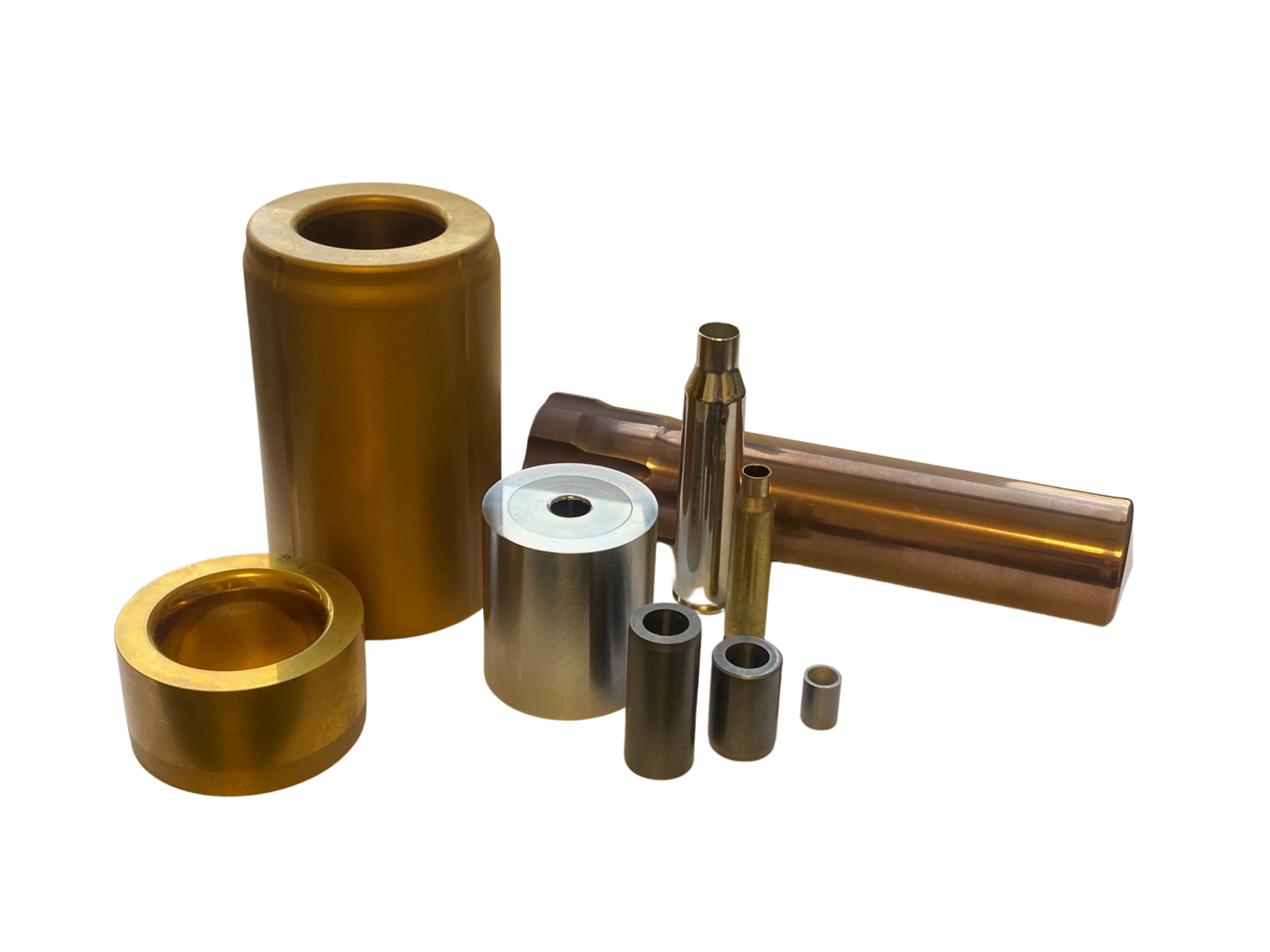
Tungsten Carbide Bushings


substances for metal forming known to man. Tungsten carbide is almost as hard as diamond and can be produced at a fraction of the cost. Tungsten carbide is now used in a wide variety of metal forming applications, from carbide dies to long lasting cutting tools. Here's a quick look at its fascinating history!

After Henri Moissan discovered tungsten carbide it took two other men to make it useful in the field of metal forming. The Osram Lamp Works in Germany needed a cheaper alternative to diamond dies for drawing the wires to be used in their lamps. Karl Schroeter and Heinrich Baumhauer experimented with bonding carbide with other metals  as cobalt, and the tungsten carbide industry was born sine it provided the necessary toughness to be used in their metal drawing process.

After that the notorious industrialist and arms manufacturer Friedrich Krupp and his company purchased the patent and further developed the sintering process. In the US the General Electric Corporation formed licenced use of the patent from Krupp and formed the Carboloy Company in order to produce tungsten carbide in the United States. The Carboloy company branded their tungsten carbide as "Carboloy." Carboloy tools were tested in General Electric plants and came to public attention and offered to the publiaround 1928.

Soon other patents and advancements were put forth, for example Dr. Balke invented a tantalum carbide that was sintered with nickel, creating a superior steel cutting alloy. Dr. Balke's material, called Ramet, was resistant to the pitting while cutting steel that typical resulted in premature wearing of carboloy.

Other advancements were made throughout the 1930's in the USA as the metallurgist Philip McKenna of the Vanadium Alloy Steel Company improved upon the pitting issue and created a titanium carbide alloy. 

As development of tungsten carbide continued its price dropped considerably, going from extremely expensive (but nowhere near the cost of the diamonds it replaced!) to a standard in manufacturing across a wide varieties of industries. Originally carbide was used very sparingly due to its high cost of manufacturing, to save on tungsten carbide it would only be used on the tips of cutting tools for example through the use of brazing techniques. However, as the 19th century progressed and its cost decreased large carbide dies and tools have become common. 

Today carbide dies are used in the cold forming industry to make all sorts of nuts, bolts and millions of other forms. The mining industry makes frequent use of tungsten carbide in their drills, ammunitions manufacturers use them to form shell casings and even some ballistics. Honestly, this section of the article describing it's multiple uses across a wide variety of industries could balloon into a book. Tungsten Carbide in all its varieties will be a major part of production long into the future!


Friday, August 31, 2018

Carbide Die Company jobs / hiring

The carbide die industry in the United States is doing better than it has in the past 17 years. However, a problem remains - lack of skilled workers. After decades of dwindling US manufacturing and the great recession hit in 2010 - 2012, many intelligent and skilled machinist migrated to different fields. Now, those that are qualified are older and fewer. This is a great opportunity for the millennial generation since many employers are willing to train younger workers.

That being said, if you are seeking emplacement in South East Michigan and are either experienced and skilled or want to learn here's an opportunity for you. IF your not in S.E. Michingan.. just look around, people are hiring!

Company seeking someone for the following job/career as a carbide die maker / machinist / Grinder.

Positions Available: ID Grinder and OD Grinder

Immediate openings.

Carbide Die Jobs

https://detroit.craigslist.org/wyn/mnu/d/machinist-od-grinder-and-id/6683249225.html


Carbide Die
Carbide Die Used for Drawing Steel Tubes

Wednesday, November 1, 2017

Carbide Die Blog Shop Humor

Welcome to yet another installment of Carbide Die Blog tool and die humor... We are going to take aim at our overseas competition today in a light hearted look at a few things.

But, wait Carbide Die Blog, what if I want to spend less money and Chin..a is to expensive? Where could I get something manufactured for dirt cheap.
Well you should try Chin B.


of course errors slip by, so here's a sign for the season..

*cemetery!!!

You had one job!!!

Here's what happens when manufacturing instructions get taken a little to literally.


and finally.... a little note about safety.


Remember: Sometimes a little hazard analysis can save an empire and help continue your rule over the galaxy!

Thanks for visiting the Carbide Dies Blog!

Tuesday, June 9, 2015

U.S. Manufacturing Growth Accelerates

For the first time in six months, U.S. manufacturing has grown substantially from more new orders
US Manufacturing Accelerates
US Manufacturing - Cautiously Optimistic
being placed and more employees being put to work.
The increase in factory activity indicates the economy may be beginning to grow again after dwindling for the first three months of the year. Yet, overall growth remains slow, due to a multitude of factors. Americans have been unwilling to spend, even though there is more work and even low gas prices allowing more flexibility to spend.
The value of the dollar increasing acutely has made U.S. goods more expensive overseas, decreasing exports. Economists predict the economy may grow at a 2 percent annual pace in the April-June quarter, after a 0.7 percent decline in the first three months of the year.
With the end of a labor dispute at West Coast ports, manufacturers have benefited from parts and raw materials flowing more freely.
Signs also point to the stabilizing of overseas economies. China's manufacturing sector expanded last month, although not very rapidly, reported by an official manufacturing index. Manufacturing in the European Union has also picked up.
U.S. export orders did not see any rise or fall last month, after increasing in April. This is still preferred to the three months of the first quarter when export orders were receding.
Fourteen industries reported growth last month, including clothing, furniture, paper products and food and beverages. Two industries reported contraction: textile mills and computers and electronics.
The dramatic drop in the price of oil, from $110 a barrel last June to less than $50 in January, has caused drilling companies to cut back heavily on digging and building new wells. These cut backs have drastically reduced the demand for steel pipe and other equipment.
Business spending on buildings and equipment dropped 2.8 percent in the first quarter, the largest drop in more than five years. Despite all of this, there are signs that businesses, specifically those outside oil and gas, are spending more on expensive items such as machinery.


Tuesday, September 23, 2014

How to become a Die Maker


When it comes to metalworking trades tool and die makers are at the top. They are extremely versatile with their hands for creating parts, as well as with machines to produce high precision parts. Their abilities go beyond that of the average machinist. They are capable of designing and fabricating tools with no supervision. With these skills available, tool and die makers are a tremendous asset in any manufacturing facility.

Steps to become a Die Maker Step 1
1. Master basic math. Understand addition, subtraction, and division. Knowing some shop trigonometry is good for calculating bolt circles and finding the length of triangles. Basic algebra can also be handy for applying handbook formulas

Become a Die Maker Step 2
2. Learn computer drafting. Vocational and technical schools' machining programs are a good place to learn these types of skills. Learn to create and interpret mechanical drawings.

Become a Die Maker Step 3
3. Enter an apprenticeship program at a tool and die shop while in high school, if possible. Apprentices do simple tasks such as drilling, de-burring, and sweeping in the beginning. Tasks will become more challenging as time goes on. Apprentices learn the lathe, mill and surface grinder. Apprenticeships typically last 2 to 4 years.

Become a Tool and Die Maker Step 4
4. Study machine tool technology at a good vocational trade school. Programs vary from school to school so make sure you are studying at one that has various machines to learn from, such as a wire EDM (electrostatic discharge machining) tool. Also, make sure they have good CNC (computer numerically controlled) programming courses, as this will make things easier later in your career. Try to get hands-on experience in a shop as well, rather than studying strictly in a classroom. The heart of your education will be in the types of projects you will be making in the course. A typical machine tool technology program will last two years.

Become a Die Maker Step 5
5. Get a copy of the Machinery Handbook and refer to it often. This is an excellent reference for answering any machining problem.

Become a Tool and Die Maker Step 6
6. Buy a set of good high quality precision tools like 1-2-3 inch micrometers, and a square set, along with a 7- or 11-drawer machinists toolbox. An electronic caliper is a plus also. Try to stay away from generic tools because these seem to be less durable. Instead, invest in high quality tools like Starrett and Mitutoyo, top names in the trade. If money is tight, obtain tools gradually, as you need them, over time, until you have your own set. Get the ones you need most first.

Become a Die Maker Step 7
7. Once you land a job, focus on gaining experience. Learn from veteran tool and die makers. They can and often will share many tips they have learned over the years.

Become a Die Maker Step 8
8. Talk with other tool and die makers on the Internet in various discussion forums especially concerning CNC programming. Learning from those who have done it for years is the best way to help your career.

Become a Die Maker Step 9
9. Read metalworking trade publications in your spare time. Leave trade magazines in your bathroom.

Become a Die Maker Step 10
10. If you want to further your career in the tool and die trade, you may want to move into supervision or teaching. A Bachelor's degree in almost any field along with tool and die experience can be very beneficial in obtaining a supervisor's job in manufacturing and/or teaching.

Monday, July 7, 2014

Where are Carbide Die Companies Located?

Tool and die is the heart of manufacturing, specialized workers make the parts that make the parts. These dies need to be made special, one at a time by skilled die makers. Unfortunately, the number of companies that do this has been contracting since the late 90's. However, current trends show that this may be reversing. Particularly among highly specialized die makers, such as carbide die companies. So where are these companies located?

According to the US bureau of Labor Statistics (2001 to 2010)
Top States in Tool, Die, and Mold Employment  States ranked by 2010 employment.

State                  2001              2010              Percent Change 
Michigan          30,208           18,871                     -27%
Ohio                17,056           11,075                     -28
Illinois              12,822             6,815                     -31
Pennsylvania    11,811             6,476                     -30
Wisconsin          7,309             5,359                     -13
Indiana               8,571            5,228                     -31
California           7,253             4,885                     -23
Missouri             4,371            3,133                     -11
New York          5,171            2,783                    -30
Minnesota           3,933            2,749                    -13

Clearly, tool and die companies are mostly located in the Midwest of the United States. American tool and die companies face there toughest competition from Japan, although the Japanese manufacturers face longer lead times. This extended lead time causes problems due to lean manufacturing principles. Currently the Chinese tool and die industry seems to only be producing lower quality tooling. This is particularly true in the carbide die industry, where the Chinese dies tend to fall apart under the rigors of mass production. This causes damage to other tooling and I have heard more than one person comment that they are "garbage".

Tool and die is a vital resource for any manufacturing economy, and one that America would do well to maintain.

Wednesday, June 18, 2014

Tool & Die Life

As we all know, tool and die can be frustrating at times. Late parts, people freaking out about machines being down. These are called Yelling Plants. People spend there time screaming about how tens of thousands of dollars are being lost because a certain die isn't here. So relax for a second and enjoy...

 "Tis not our job to ask why, tis our job to tool and die"

Also, check out the tool and die quotes


Thursday, June 6, 2013

Tool and Die Quotes and Sayings

Machinists are famous for making everything we use or the parts that make the things we use... but only slightly less know for their quotes and colorful phrases.  Terms like screw, tailstock, ball, butt and nuts are common. So here are some of the quotes that have come out of the tool and die trade, enjoy!

A machinist is a man that washes his hands before and after he pees.

Last week I couldn't spell Machinist now I are one!

"Machinist's do it accurately"

Machinists do it "round and round" and "up and down.

"Happiness is a good tight screw".

Your car cost $40,000, So What, My machine cost $150,000 and it will make car parts.

If you Break it We can Make.

I worked my whole life as a Machinist, and all I got was Dead Nuts!

May the laws of physics be with you

You can always tell a good Master machinist, They still have all of there fingers!

It can be done three ways:
           GOOD
           FAST
           CHEAP
You only get to pick two of the three
If it is done GOOD and FAST it can't be CHEAP.
If it is done GOOD and CHEAP it can't be FAST.
IF it is done FAST and CHEAP it can't be GOOD.

"He who does not specify what he wants, deserves what he gets."

MINE IS NOT TO ASK WHY
MINE IS JUST TO TOOL AND DIE !

I am a Machinist. My ability to create is limited only by you inability to envision.

GOD must've been a Machinist with a killer piece of stock.

I am a Machinist. I didn't envision, plan, or design this part. But if you leave me alone long enough, I'll make it work.

The Hindenburg and the Titanic. Don't blame the Machinists. We just make whatever the Enigneers design.

How Precision Carbide Dies Deliver Measurable Manufacturing Gains

Tooling should support your production goals — not hold them back. In industries like wire drawing, fastener production, extrusion, and tube...