Showing posts with label cold forming dies. Show all posts

Sunday, February 15, 2026

Hot Forging and the Role of Carbide Inserts in High-Temperature Manufacturing

hot forging manufacturing

Hot forging shapes heated metal—often at temperatures between 1,500°F and 2,200°F—into durable, complex components. The extreme heat softens the material, allowing for better ductility, improved grain structure, and strong metallurgical performance. This makes hot forging ideal for larger structural components found in automotive, aerospace, agricultural, and industrial equipment.

Even with softer metal, hot forging puts immense stress on tooling. Many dies incorporate carbide inserts in key wear areas to maximize durability and maintain precision at high temperatures. Carbide’s resistance to abrasion and deformation makes it ideal for forging die inserts, trim dies, wear plates, and other components subjected to thermal and mechanical strain.


Read more on our website!


We produce custom carbide tooling designed to stay stable under heat and pressure—helping manufacturers improve uptime and reduce tooling costs. Contact us today to explore carbide inserts tailored to your forging applications.

Sunday, February 1, 2026

Cold Forming: Why Carbide Dies Make All the Difference

cold form dies

Cold forming, also known as cold heading, is one of the most efficient ways to produce high-volume metal parts with exceptional accuracy. Because the process shapes metal at or near room temperature, the material becomes stronger through strain hardening while maintaining a clean, consistent surface finish. This makes cold forming ideal for fasteners, bolts, and other precision components.

However, cold forming also places extreme pressure on tooling. That’s why manufacturers rely on carbide dies, specifically cold form dies, to withstand repeated high-force impacts without losing dimensional integrity. Carbide provides unmatched wear resistance and compressive strength, helping operations maintain accuracy even in demanding, high-speed environments.


Read more on our website!


We engineer precision cold form dies that deliver long tool life, reduced maintenance, and consistent part quality, cycle after cycle. Looking for custom tooling support? Our engineering team can help optimize your cold forming process. Get started today and request a quote!

Saturday, November 15, 2025

Best Carbide Grades for Extrusion Dies: Hardness Matters

extrusion die

In extrusion applications, where material is continuously forced through a die opening, friction and heat are constant challenges. Hardness and wear resistance take priority over impact strength.

Fine-grain carbide grades (K05–K20) with lower cobalt content provide excellent performance in extrusion dies, maintaining sharp edges and surface quality even under intense thermal and abrasive conditions. For long production runs or highly abrasive materials, ultra-fine carbide grades offer even greater wear resistance, helping you maintain dimensional consistency and avoid costly die erosion.


While cold form dies require toughness to resist cracking and chipping, extrusion dies depend on hardness and wear stability to withstand continuous material flow. Understanding these distinctions is key to selecting the right carbide grade for your process.


We work with manufacturers to fine-tune carbide selection for each application—whether it’s cold form dies or extrusion tooling. From material choice to final finishing, our dies are designed to deliver precision, consistency, and longevity under the toughest manufacturing conditions.


Contact Raven Carbide Die today to discuss your tooling needs or request a quote. Our team can help you choose the best carbide grade for your cold forming or extrusion operation—ensuring maximum performance, durability, and value.


Saturday, November 1, 2025

Choosing the Right Carbide Grade for Cold Form Dies

Cold forming is a process that subjects dies to tremendous stress through compression. For manufacturers, selecting the right carbide grade is key to preventing cracking, chipping, and premature wear.


Medium to coarse-grain carbide grades (typically in the K20–K40 range) with higher cobalt content are best suited for Cold Form Dies. These grades provide the toughness needed to withstand repeated impact while maintaining consistent performance and dimensional accuracy.


Submicron carbide grades are another excellent choice for smaller, high-precision parts where superior finish and tight tolerances are critical. By using the optimal carbide composition, you can significantly extend die life and reduce downtime, ensuring maximum productivity across production runs. Read more about choosing the right carbide grade for cold form dies in our latest article.


We specialize in matching carbide materials to your forming process. Our precision engineering ensures your dies deliver lasting performance under even the most demanding conditions. 


Contact Raven Carbide Die today to discuss your tooling needs or request a quote. Our experienced team can help you choose the best carbide grade for your cold forming or extrusion operation—ensuring maximum performance, durability, and value.

Friday, October 16, 2020

Types of Carbide Dies


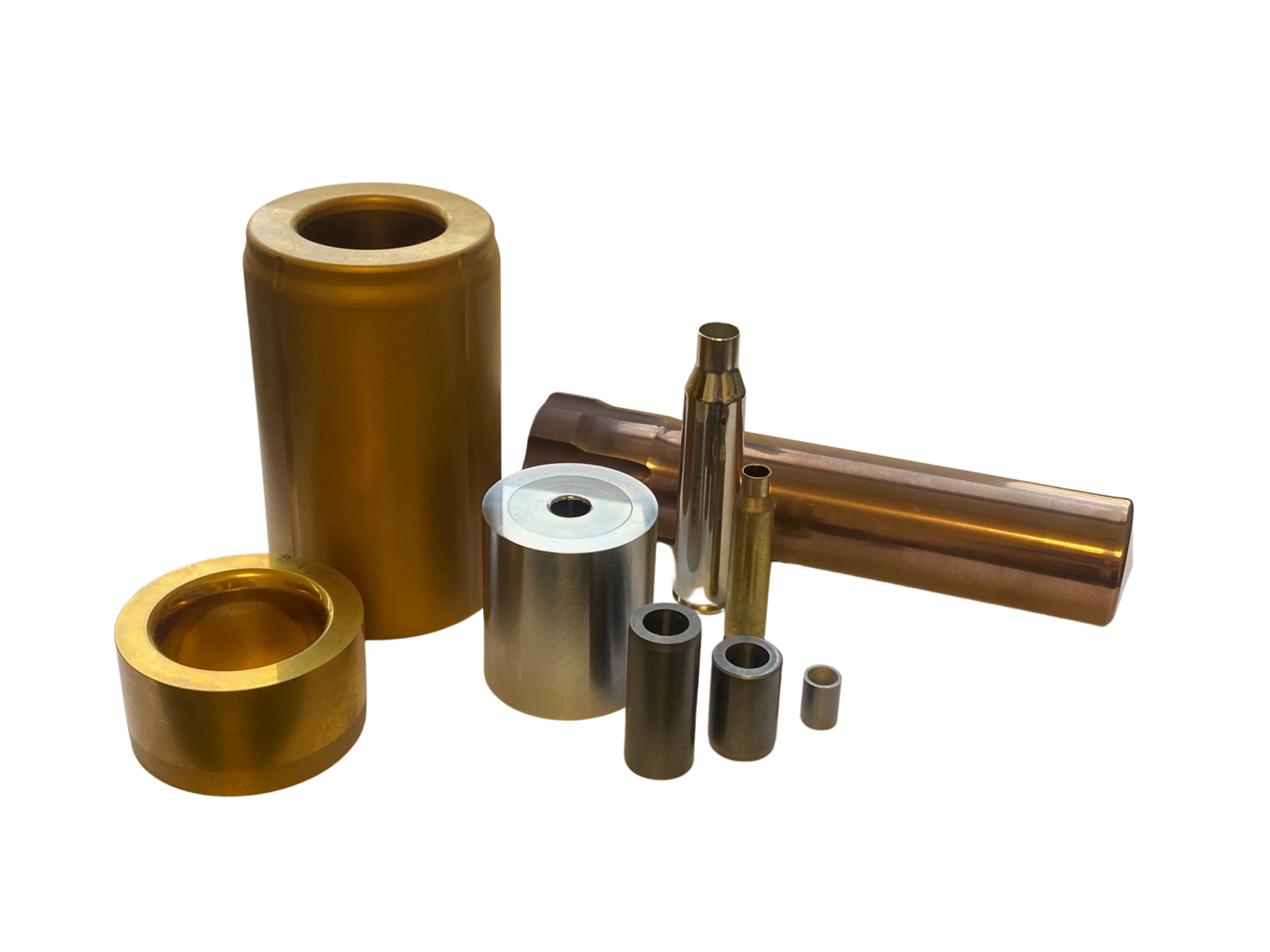
Let's get back to the basics. The following carbide dies are used in a wide variety of industries to make everything from nuts and bolts to flutes and missiles. Tungsten carbide dies and tooling have become a major part of modern manufacturing, utilizing the strength of tungsten carbide to form metals and other hard materials into a vast array of shapes, parts and products!

Tungsten Carbide Cold Forming Dies
Cold forming, or cold heading, starts with a cold metal slug placed into a die that is hit with a
Cold Forming Dies
As Carbide Dies become more important,
you should know your carbide dies and tooling!
heavy strike to shape it into its desired form. The force from the strike causes the metal to flow
into the desired shape inside the carbide die by exceeding the metal’s yield strength. Modern cold
forming is commonly used for rapidly forming metal parts such as screws, bolts and many other
fasteners.

Tungsten Carbide Drawing Dies 
Drawing (Draw Dies) dies are typically used to shape wire, rod, bar, and tube. Commonly drawn materials include steel, aluminum, and copper.

Tungsten carbide has a high compression strength allowing it to handle extreme pressure; this
makes the material ideal for use in drawing dies. Most major manufacturers use carbide dies in
the drawing process. Drawn materials include mild steel, stainless steel and high carbon steel as
well as other steel alloys. Softer materials, like aluminum or brass, are frequently drawn
as well.

The wire drawing process involves drawing wire through a die to reduce the diameter of the wire
to the desired size while the volume remains the same. Wires are sized by
drawing them through a series of drawing dies, with each die having slightly smaller internal
diameter than the one preceding it to gradually reduce the width of the wire. The final die in the
series forms the wire to its target size.

Tube, or pipe, drawing dies are commonly round, hex or square, but can be made into any shape
desired by the manufacturer. The process of drawing tubing is similar to the wire drawing
process; however, a mandrel is used to form the inner dimensions of the tubing. The mandrel is
inside the tube, or pipe, and situated inside the die. As the tube is drawn through the die it is
being shaped on the inside by the mandrel, which establishes the wall thickness and inner
diameter. A properly formed mandrel will provide for a smooth surface on the inside of the tube or
pipe.

Bars and Rods are drawn in a similar fashion to wire however only they tend to be much thicker. A wide variety of metals are used in this application, including many steel and copper alloys. A cut-off
knife is used to size the rods and bars to length.

Carbide Extrusion Dies

Extrusion dies are typically used in a process where a slug is pushed through the die, forming the
carbide die


desired cross sectional area. A mandrel is used in the process if the application is for tubing, or
pipes. Extrusion can be performed on a wide variety of materials and at various temperatures to
obtain the desired properties of the extruded product. Materials that can be formed with extrusion
dies include steel, copper, aluminum, tin, lead, nickel and even plastic. Products formed through
extrusion operations include pipe, wire, rods, bars, tubes, and welding electrodes.


For information about other types of carbide tooling, check out our comparison of carbide bushings to steel bushings. For information about carbide die suppliers see our recomended Carbide Dies suppliers page.

How Precision Carbide Dies Deliver Measurable Manufacturing Gains

Tooling should support your production goals — not hold them back. In industries like wire drawing, fastener production, extrusion, and tube...